
The sound of moving water changes a yard. It replaces traffic noise with something elemental, draws birds and butterflies into the space, and creates a focal point that makes even a modest landscape feel deliberate and alive. In Northeast Florida, where we spend the better part of the year outdoors, a well-chosen water feature is not a luxury addition. It is one of the most effective ways to elevate an outdoor living space from pleasant to genuinely compelling.
But choosing the right water feature for your property involves more than picking a style you admire in a magazine. The high water table across Fernandina Beach and Amelia Island, our sandy soils, the salt air that drifts inland from the Atlantic, and the sheer volume of rain our region receives between June and September all shape which features perform well here and which ones become maintenance headaches. What works beautifully in a Mediterranean climate or a Midwestern backyard may not translate to Nassau County without thoughtful adaptation.
This guide walks through the most popular water feature options for Northeast Florida homes, what each one requires in terms of space, maintenance, and investment, and how to match a feature to your landscape, your lifestyle, and the realities of our coastal climate.
Bubbling Rocks and Boulder Fountains
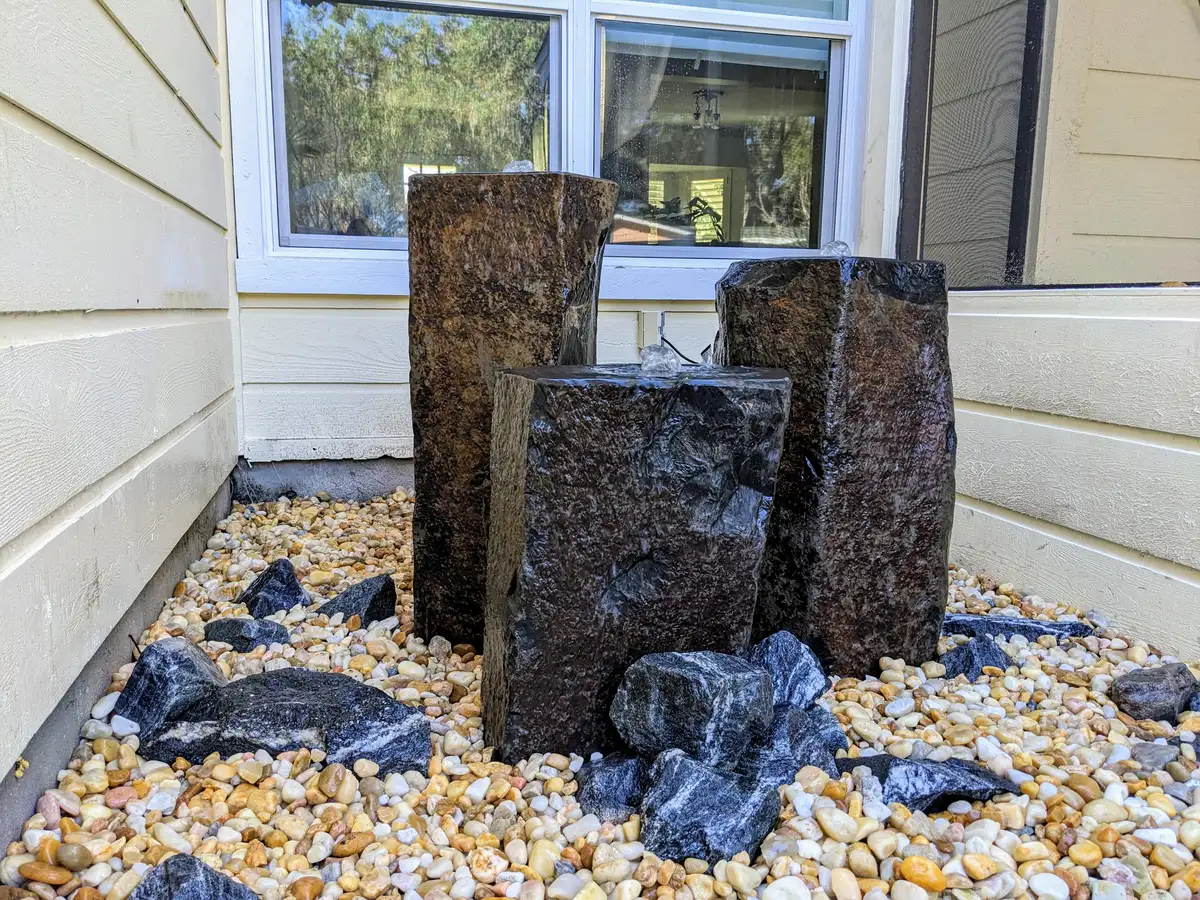
If you have never had a water feature before and want to start with something manageable, a bubbling rock or boulder fountain is the most forgiving entry point. A single natural stone, drilled and fitted with a recirculating pump, sits atop a buried basin. Water wells up through the stone, flows over its surface, and disappears back into the basin below. There is no standing water, no pond to maintain, and no complex plumbing.
Why They Work in Northeast Florida
Bubbling rocks are ideal for our climate for several practical reasons. The absence of standing water eliminates mosquito breeding habitat, which is a genuine concern from May through October in any coastal Florida landscape. The buried basin sits below grade, unaffected by the high water table that can complicate deeper excavation. And because the feature is essentially self-contained, salt air exposure is limited to the stone surface itself, which weathers beautifully over time rather than corroding.
From a design perspective, a bubbling rock integrates naturally into the kind of naturalistic landscape design that defines our work at Bloom and Stone. Positioned at the edge of a planting bed or alongside a natural stone walkway, it looks like it has always been there. The stone can be selected to match or complement existing hardscape materials, whether that is the warm tones of travertine, the coastal gray of coquina, or the organic texture of Tennessee fieldstone.
Space and Budget
A bubbling rock works in spaces as compact as four feet by four feet, making it suitable for courtyard gardens, side yards, and intimate patio settings. It is also the most affordable water feature category, with installed costs typically ranging from a few thousand dollars for a single stone to moderately more for a multi-boulder arrangement with accent plantings. The ongoing cost is minimal: the recirculating pump uses roughly the same electricity as a small desk lamp, and maintenance consists of occasional water top-offs during dry periods and an annual pump cleaning.
Recirculating Streams and Dry Creek Beds
A recirculating stream creates the impression of a natural waterway flowing through your landscape. Water is pumped from a buried reservoir at the low end of the stream to a headwater point, where it flows downhill over a bed of natural stone, disappearing back into the reservoir to complete the cycle. The key word is impression. This is not a natural spring or creek. It is a carefully engineered feature that mimics one.
Design Considerations for Flat Terrain
The challenge in most of Nassau County and across the greater Jacksonville area is that our terrain is remarkably flat. A stream needs grade change to flow, and in Fernandina Beach, that grade change rarely exists naturally. The solution is to create it. Imported fill or carefully shaped berms along the stream corridor produce enough elevation change for water to move convincingly. A drop of six to twelve inches over a twenty-foot run is sufficient when the streambed is properly constructed with riffles and pools that slow and accelerate the water at intervals.
The adjacent plantings are what sell the illusion. Native grasses like muhly grass and fakahatchee grass planted along the stream banks, interspersed with ferns, blue flag iris, and canna lilies, create the sense of a riparian corridor that has existed for years rather than weeks. This is where landscape design and water feature design become inseparable. The stream is only as convincing as the landscape around it.
Dry Creek Beds as an Alternative
For homeowners who want the visual appeal of a stream without the pump, plumbing, and ongoing maintenance, a dry creek bed achieves a similar effect using stone alone. River rock and natural boulders are arranged in a meandering channel that suggests the path of water through the landscape. During rain events, which are frequent and heavy during our wet season, these channels actively carry stormwater, providing genuine drainage function alongside their aesthetic role.
Dry creek beds pair exceptionally well with rain garden plantings at their terminus, turning a drainage solution into a landscape feature that supports local ecology. In a region that receives fifty to sixty inches of rainfall annually, designing with water rather than against it is a philosophy that pays dividends.
Natural Ponds
A natural pond is the most ambitious water feature option and the one that transforms a landscape most dramatically. Done well, it becomes the gravitational center of the entire outdoor space, a place where the family gathers, where herons visit at dawn, and where the quality of light on water becomes part of the daily experience of the yard.
Working With Northeast Florida's Water Table
The high water table across Amelia Island and much of Nassau County is both a challenge and an advantage for pond construction. Excavation below two to three feet often encounters groundwater, which means the liner and underlayment system must be engineered to handle hydrostatic pressure from below as well as the weight of water from above. This is not a weekend project or a liner-in-a-hole proposition. It requires proper engineering, grading, and construction expertise.
The advantage is that supplemental water is rarely needed. Where ponds in drier climates lose inches of water per week to evaporation and must be continuously topped off, our ponds benefit from regular rainfall and ambient humidity that keeps evaporation losses modest. During the wet season, overflow management becomes more relevant than water supply.
Pond Maintenance in a Subtropical Climate
Florida's warm temperatures promote algae growth year-round, which is the single largest maintenance consideration for pond owners in our area. A well-designed pond manages this through a combination of biological filtration, beneficial bacteria, adequate water circulation, and strategic shade from aquatic and marginal plantings. Water lilies, pickerelweed, and native emergent plants are not just decorative. They shade the water surface, compete with algae for nutrients, and provide habitat structure for the small ecosystem the pond supports.
Expect to spend thirty to sixty minutes per week on pond maintenance during the warm months and less during the mild winter. This includes checking pump and filter function, removing any accumulated debris from the skimmer, and monitoring water clarity. For homeowners who travel frequently or prefer a hands-off approach, a bubbling rock or stream is a better fit.
Spillway Bowls and Formal Fountains
Not every landscape calls for a naturalistic water feature. For properties with a more structured outdoor living space, a clean-lined patio, or an architectural style that favors symmetry, a spillway bowl or formal fountain provides the sensory benefits of water within a more composed aesthetic.
Spillway Bowls
A spillway bowl is a shallow, typically rectangular basin, often made from cast stone, copper, or corten steel, mounted on a wall or pedestal. Water fills the basin and spills over one edge in a smooth, continuous sheet, falling into a catch basin below. The effect is sleek and contemporary, the visual equivalent of a whisper rather than a shout. These are particularly effective on privacy walls adjacent to dining areas, where the sound of falling water masks conversation from neighbors and street noise.
Tiered and Pedestal Fountains
Traditional tiered fountains work well as centerpieces in formal garden rooms, courtyard entries, and circular drive islands. In our climate, choose materials that resist salt corrosion and UV degradation. Cast stone holds up well. Lightweight resin reproductions do not. The pump and basin should be accessible for the periodic cleaning that Florida's organic environment demands, and the fountain should be plumbed with a float valve that automatically tops off water lost to evaporation.
Matching a Water Feature to Your Property
The best water feature for your yard is the one that fits three criteria simultaneously: it complements the scale and style of your landscape, it aligns with the amount of maintenance you are willing to perform, and it respects the site conditions of your specific property.
Scale
A common mistake is choosing a feature that is too small for the space. A modest bubbling rock that looks perfect in a courtyard garden disappears in a half-acre lawn. Conversely, a large pond on a compact lot can overwhelm the landscape and leave insufficient room for the plantings, stonework, and seating areas that give the space balance. As a general guideline, the water feature should occupy roughly five to ten percent of the visible landscape area it anchors.
Proximity to the Home
Place the feature where you will actually experience it. The sound of water drops off quickly with distance, so a bubbling rock forty feet from the patio provides visual interest but little auditory benefit. Positioning a water feature within fifteen to twenty feet of your primary seating area, whether that is the patio, a fire pit circle, or an outdoor dining space, ensures you receive both the visual and acoustic benefits. If the feature includes landscape lighting, proximity to evening gathering spots becomes even more important.
Sun and Shade
In Northeast Florida, features in full sun require more frequent water top-offs and are more prone to algae growth. Features in heavy shade accumulate leaf litter and organic debris faster. The ideal placement is in filtered light, receiving morning sun and afternoon shade, which is the same exposure most planting beds in our region prefer. If your site does not offer this naturally, strategic tree planting can create it within a few growing seasons.
When to Start Planning
May is the ideal month to begin designing a water feature for installation later this year. The design and material selection process typically takes three to four weeks, permitting another two to three, and installation one to three weeks depending on complexity. Starting the conversation now means your feature can be operational by mid-summer, with the balance of the season to enjoy it and for surrounding plantings to establish before the cooler months.
If you have been considering adding water to your landscape, or if you are planning a broader backyard renovation that might include a water feature as one element of a larger outdoor living space, we would welcome the chance to visit your property, understand how you use your yard, and help you choose the feature that will bring the most value and enjoyment for years to come.